In rapidly expanding commercial and residential hubs across Sub-Saharan and North Africa—from Lagos and Accra to Nairobi, Cairo, and Luanda—architects and lead contractors face severe environmental and logistical challenges. High ambient temperatures, intense ultraviolet (UV) radiation, localized heavy downpours, and structural thermal movement frequently cause traditional exterior materials to fail prematurely.
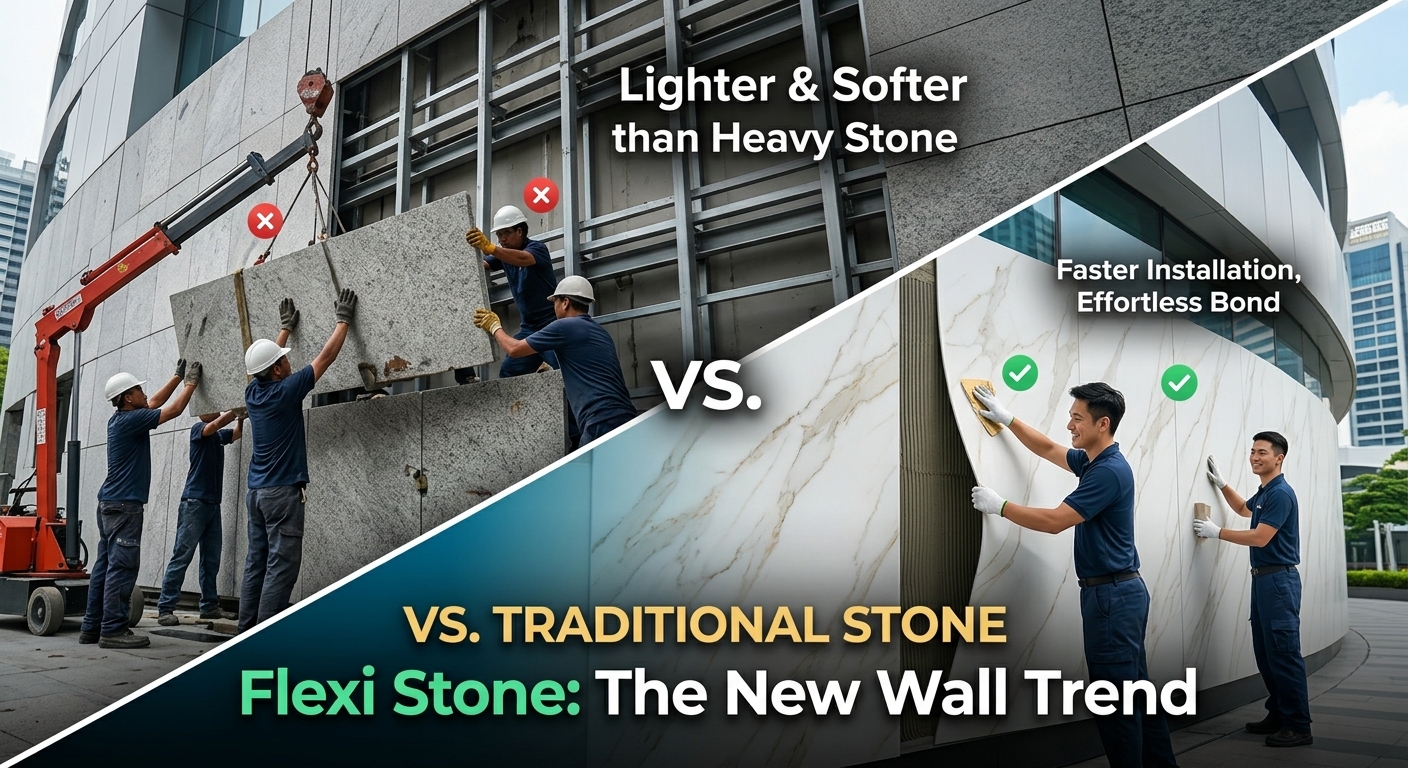
Moreover, conventional stone cladding requires complex wet-mortar masonry, heavy crane lift equipment, and highly skilled specialized labor—factors that consistently lead to project delays, inflated site overheads, and high material waste.
Flexi Stone provides an ultra-lightweight, highly durable, and environmentally adaptive solution engineered specifically to overcome harsh climate conditions while dramatically streamlining site workflows.
Technical Performance: Thriving in African Climates
1. Thermal Shock and Intense UV Resistance
Under direct tropical and desert sun, building exteriors frequently endure surface temperatures exceeding 65°C, followed by sudden cooling during nightfall or rainstorms. Rigid granite, marble, and heavy concrete panels expand and contract rapidly, causing micro-fractures, grout failure, and dangerous delamination.
Elastic Mineral-Polymer Matrix: Engineered from natural stone powder bonded with cross-linked polymers, Flexi Stone retains an elastic modulus that absorbs thermal expansion and contraction without cracking or buckling.
Anti-Fading UV Stability: Formulated with high-grade inorganic pigments and UV-resistant binders, the surface maintains vibrant, natural stone aesthetic integrity even under continuous high-solar radiation.
2. Tropical Rainfall Protection and Breathability
During intense rainy seasons, moisture ingress behind exterior cladding leads to efflorescence (white salt deposits), interior mold growth, and mortar breakdown.
Hydrophobic Sealing Barrier: Flexi Stone features zero liquid water absorption while remaining micro-porous to water vapor. This allows trapped moisture within the wall substrate to evaporate outward without causing surface blisters or adhesive breakdown.
Streamlined On-Site Workflows: Eliminating Construction Bottlenecks
In regional markets where specialized heavy machinery and technical masonry teams may be scarce or cost-prohibitive, construction efficiency is the single most critical factor for project profitability.
Flexi Stone fundamentally redefines site installation mechanics through Intuitive Application Engineering:
Zero Heavy Machinery Required: Weighing just 3–5 kg/m² (compared to 40–80 kg/m² for traditional natural stone), full-size panels can be manually transported, positioned, and installed by a standard two-person crew. No cranes, mechanical hoists, or structural steel dry-hanging frames are needed.
Standardized Dry-Cut Fitting: Panels can be easily trimmed directly on-site using standard utility knives or fine-tooth saws. This eliminates the need for expensive high-power wet-cut stone machinery, wet-saws, or multi-phase precision cutting setups on site.
Simplified Adhesive Application Method: Applied using a straightforward full-bed tile adhesive technique directly over cement render, brickwork, or light steel frames. The intuitive process removes technical barriers, eliminating learning curves for general site labor and guaranteeing rapid, error-free daily square-meter progress.
Up to 70% Faster Site Completion: By removing complex multi-tier preparation steps, structural anchor welding, and lengthy mortar curing cycles, site managers can achieve faster project handovers with minimal site supervision overhead.
FAQ: Technical & Project Direct Answers
Q1: How does Flexi Stone handle extreme desert heat and severe thermal movement on high-rise facades?
A: Flexi Stone is engineered to withstand extreme surface temperatures ranging from -30°C to +80°C. Unlike rigid natural stone slabs that require heavy steel anchors to accommodate building movement, Flexi Stone’s inherent flexibility allows it to flex naturally with structural thermal expansion. It is applied via direct adhesion, completely eliminating the thermal bridging and structural shearing hazards common in extreme climate zones.
Q2: Why is Flexi Stone significantly faster to install on African job sites compared to traditional stone tiles or granite slabs?
A: Flexi Stone eliminates the need for heavy structural reinforcement, dry-hanging steel frames, wet-cutting equipment, and specialized stone masons. Because the panels weigh under 5 kg per square meter and can be cut using basic site tools, general installation teams can complete up to 3 to 4 times more surface area per day compared to traditional masonry crews. This drastically reduces site management complexity, equipment rental costs, and overall project duration.
Q3: Can Flexi Stone be applied directly over uneven substrates or existing exterior finishes during building renovations?
A: Yes. Due to its lightweight and flexible nature, Flexi Stone can be bonded directly onto cement plaster, AAC blocks, fair-faced concrete, exterior drywall, and even existing ceramic or painted surfaces (with proper surface priming). This bypasses costly, labor-intensive demolition work and structural wall reinforcement, making it the premier choice for fast-track commercial refits and building modernizations.
Q4: How does Flexi Stone prevent moisture damage, efflorescence, and mold in humid, high-rainfall regions?
A: Flexi Stone incorporates an advanced hydrophobic formulation that prevents exterior water penetration while maintaining breathability. Because it does not absorb rain or environmental moisture, it prevents the migration of alkali salts (efflorescence) to the surface and stops mold spores from taking root, ensuring a maintenance-free facade throughout heavy monsoon cycles.
Q5: What are the export shipping and site logistics advantages of Flexi Stone for African imports?
A: Traditional stone slabs consume immense shipping weight capacity and frequently suffer 15%–30% transit breakage over rough overland transport routes. A single standard 20-foot container can transport over 4,000 square meters of Flexi Stone—more than five times the coverage volume of thick stone slabs. Furthermore, its flexible composite structure guarantees zero edge-chipping or breakage during long-distance ocean and overland transit.